SpacetimeDB Is Fast — But Their Benchmark Doesn't Prove It
Last month, SpacetimeDB released this banger of a video. Cool marketing, I like it. But as a developer, I somehow can’t believe the benchmark numbers they’re showing at the end of the video. Node.js + Postgres can only do 4,000 TPS? Something’s not right.
I’ve been using Postgres for years, and I’ve never seen it perform that poorly. I’ve also never seen a benchmark that compares a database to a backend. It’s like comparing apples to oranges.
So I dug into the benchmark code and found a few things that I think are unfair, and in the end I built a fairer benchmark to prove my point.
The original benchmark
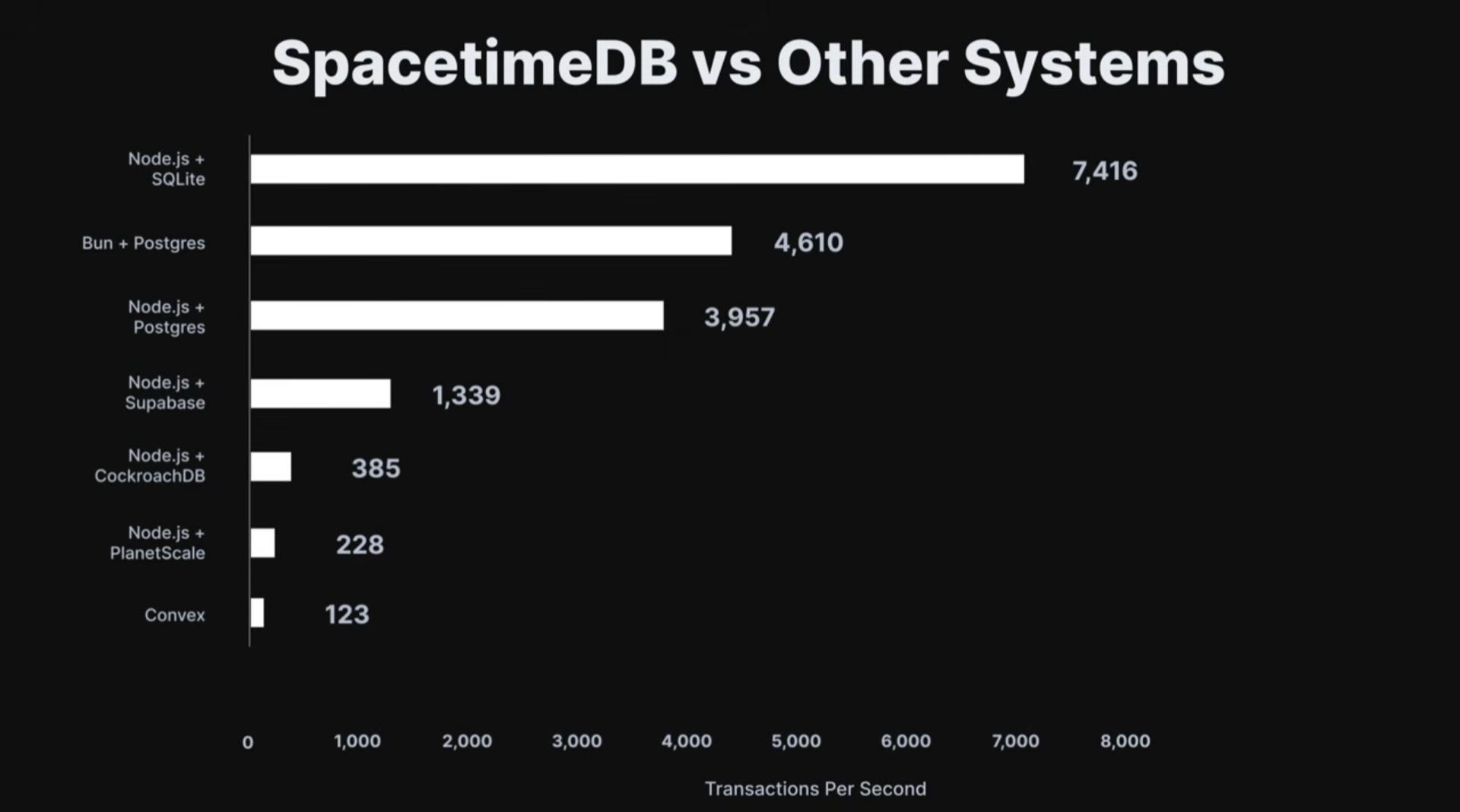
The keynote-2 benchmark compares SpacetimeDB, an integrated database and backend platform, against Node.js + PostgreSQL, Supabase, Convex, and CockroachDB using a bank-transfer scenario. On the surface, this sounds reasonable. But let’s dig into the code to understand what is actually being measured.
Rust Client vs. Node.js Script
Looking through the code, we see a big red flag.
async function runBenchmark(system: ConnectorKey): Promise<BenchResult | null> {
  if (system === 'spacetimedbRustClient') {
    return await runBenchmarkStdb();
  } else {
    return await runBenchmarkOther(system);
  }
}
SpacetimeDB benchmark client is different from the rest. In fact, SpacetimeDB benchmark client is a compiled rust client, while all of the other uses an in-process Node.js script. This isn’t just comparing backend + database, it’s comparing the entire client-side stack too.
Rust’s async runtime, memory management, and compiled binary performance give it a massive advantage in raw throughput before the request even hits the server. A fair benchmark would have to use the same client language for all targets.
WebSocket vs. HTTP
SpacetimeDB uses a persistent WebSocket connection — one handshake, then a stream of binary messages. The competitors use HTTP — a new TCP connection (or at best, a keep-alive reuse) with full HTTP headers on every request.
SpacetimeDB actually has an HTTP mode. However, they clearly didn’t do that. I wonder why.
Warmup Asymmetry
The SpacetimeDB benchmark includes a warmup phase for the Rust client — JIT optimization, connection pooling, and memory allocation all happen before measurement begins. The Node.js benchmarks have no equivalent warmup period.
Single Query ≠ Transaction
await client.query('BEGIN');

const rowsResult = await client.query<{ id: number; balance: string }>({
    name: PREPARED.transferSelectForUpdate.name,
    text: PREPARED.transferSelectForUpdate.text,
    values: [fromId, toId],
});
const rows = rowsResult.rows;

if (rows.length !== 2) {
    throw new Error('account_missing');
}

const [first, second] = rows;
const fromRow = first.id === fromId ? first : second;
const toRow = first.id === fromId ? second : first;
const fromBalance = BigInt(fromRow.balance);

if (fromBalance >= delta) {
    const toBalance = BigInt(toRow.balance);

    await client.query({
    name: PREPARED.transferUpdateBalance.name,
    text: PREPARED.transferUpdateBalance.text,
    values: [(fromBalance - delta).toString(), fromId],
    });

    await client.query({
    name: PREPARED.transferUpdateBalance.name,
    text: PREPARED.transferUpdateBalance.text,
    values: [(toBalance + delta).toString(), toId],
    });
}

await client.query('COMMIT');
SpacetimeDB reducers run an atomic transaction by design: read two rows, validate, update two rows — all in one single atomic call.
export const transfer = spacetimedb.reducer(
  { from: t.u32(), to: t.u32(), amount: t.u32() },
  (ctx, { from, to, amount: amt }) => {
    const accounts = ctx.db.account;
    const byId = accounts.id;

    const fromRow = byId.find(from)!;
    const toRow = byId.find(to)!;

    const amount = BigInt(amt);
    if (fromRow.balance < amount) {
      throw new SenderError('insufficient_funds');
    }

    byId.update({
      id: from,
      balance: fromRow.balance - amount,
    });

    byId.update({
      id: to,
      balance: toRow.balance + amount,
    });
  },
);
However, for the postgres RPC server, they have to execute multiple network hops in order to start a transaction, validates, runs two UPDATE statements, and commits. There are really unneccessary and can be done with a single network hops.
A Fairer Benchmark
Well, I really not sastisfy with the number they’re showing in the original benchmark. However my guts told me that SpacetimeDB should still be faster than the traditional server + database infrastructure. So I built a benchmark to verify it.
My benchmark controls for these variables by organizing comparisons into groups that share the same language and transport protocol:
| Group | Targets |
|---|---|
| I. TypeScript + HTTP | Node.js + Postgres, SpacetimeDB (TS reducer), Bun + Postgres |
| II. TypeScript + WebSocket | Node.js + Postgres, SpacetimeDB (TS reducer), Bun + Postgres |
| III. Rust + HTTP | Rust + Postgres, SpacetimeDB (Rust reducer) |
| IV. Rust + WebSocket | Rust + Postgres, SpacetimeDB (Rust reducer) |
What’s the same across all targets
- Same Rust benchmark runner for every target — no client-side language bias
- Same bank-transfer scenario — 100K accounts, Zipf-distributed selection, balance check + two updates
- Same concurrency level — identical number of concurrent connections
- Same machine — all services run in Docker on the same host
- SpacetimeDB uses both TypeScript and Rust modules, compared against servers in the matching language
- PostgreSQL competitors use the exact same single-statement transfer query (CTE with
SELECT FOR UPDATE+UPDATE)
What we’re actually measuring
Each group isolates one variable: the database/server architecture. Within a group, the language overhead and transport protocol are identical. The only difference is whether your data lives in SpacetimeDB or PostgreSQL behind a thin server.
The Results
Here are the results with 16 concurrent connections over 10 seconds:
| Target | TPS | Mean | p50 | p99 | Max |
|---|---|---|---|---|---|
| TypeScript + HTTP | |||||
| node-http | 10,193 | 1.56ms | 1.43ms | 3.91ms | 53ms |
| stdb-ts-http | 26,099 | 0.61ms | 0.50ms | 1.97ms | 212ms |
| bun-http | 10,732 | 1.49ms | 1.43ms | 2.83ms | 5ms |
| TypeScript + WebSocket | |||||
| node-ws | 5,676 | 1.24ms | 1.03ms | 3.13ms | 48ms |
| stdb-ts-ws | 51,870 | 0.31ms | 0.22ms | 1.69ms | 125ms |
| bun-ws | 7,351 | 1.15ms | 1.08ms | 2.81ms | 17ms |
| Rust + HTTP | |||||
| rust-http | 21,112 | 0.75ms | 0.73ms | 1.65ms | 4ms |
| stdb-rust-http | 29,598 | 0.54ms | 0.52ms | 0.94ms | 3ms |
| Rust + WebSocket | |||||
| rust-ws | 20,578 | 0.78ms | 0.75ms | 1.22ms | 4ms |
| stdb-rust-ws | 61,399 | 0.26ms | 0.24ms | 0.50ms | 41ms |
What the Numbers Actually Say
SpacetimeDB is genuinely fast. In every comparison group, it outperforms the traditional architecture. But the story is more nuanced than “1,000x faster”:
- TypeScript + HTTP: SpacetimeDB is ~2.5x faster than Node.js/Bun + Postgres
- TypeScript + WebSocket: SpacetimeDB is ~7–9x faster than Node.js/Bun + Postgres
- Rust + HTTP: SpacetimeDB is ~1.4x faster than Rust + Postgres
- Rust + WebSocket: SpacetimeDB is ~3x faster than Rust + Postgres
The advantage is real, particularly over WebSocket where SpacetimeDB’s architecture truly shines — no network hop to a separate database means dramatically lower latency. But the gap shrinks significantly when you use the same language and transport protocol for the comparison.
Why the WebSocket advantage is larger
SpacetimeDB’s WebSocket numbers are disproportionately better because its architecture eliminates the biggest bottleneck: the network round-trip between application server and database. Over HTTP, both sides pay similar overhead. Over WebSocket, SpacetimeDB’s co-located compute model means it only pays the cost of an in-memory function call, while the traditional stack still has to round-trip to PostgreSQL.
The Rust vs. TypeScript gap
When SpacetimeDB runs a Rust reducer, the advantage over a Rust+Postgres server is modest (~1.4x over HTTP). This tells us something important: when the application layer is already fast (compiled Rust), the bottleneck shifts to database I/O — which is where SpacetimeDB’s in-memory architecture gives its irreducible advantage.
When running a TypeScript reducer, SpacetimeDB’s advantage is larger because it eliminates both the language overhead gap and the database network hop.
The Durability Question
The elephant in the room: SpacetimeDB operates in-memory, while PostgreSQL persists to disk. This benchmark runs Postgres with synchronous_commit=off to be as charitable as possible, but WAL writes still happen, and fsync is still on.
SpacetimeDB does write commitlogs, but the hot path is memory. If you need ACID durability guarantees on every commit, the performance comparison shifts. This is a legitimate architectural tradeoff, not a flaw — but the original benchmark doesn’t acknowledge it.
Try It Yourself
The entire benchmark is open source and runs with a single docker compose up:
# Start everything
docker compose up -d

# Publish SpacetimeDB modules & init Postgres
docker compose --profile setup up spacetimedb-setup

# Run all benchmarks
cargo run --release -- --group all --seconds 10 --concurrency 16
The benchmark runner is written in Rust and uses the rlt load testing library for accurate percentile measurements.
Repository: github.com/ddwalias/spacetimedb-bench
Conclusion
SpacetimeDB’s architecture offers genuine advantages — eliminating the application-to-database network hop is a real performance win, especially for latency-sensitive workloads. But claiming “1,000x faster” based on a benchmark that compares a Rust WebSocket client against a Node.js HTTP script is like benchmarking a Ferrari against a bicycle and claiming cars are 100x faster than all other vehicles.
A fair benchmark still shows SpacetimeDB winning — by 1.4x to 9x depending on the comparison group. That’s a compelling story on its own. It doesn’t need the unfair framing.